
College admissions 8 min read
Columbia University SAT Requirements 2026: Scores & Policy
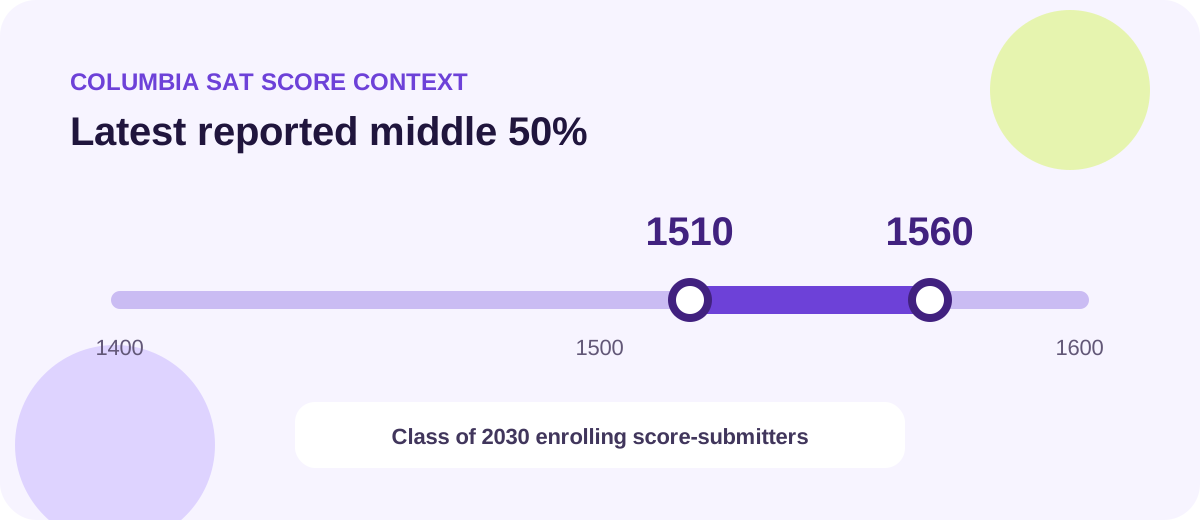
Columbia does not require SAT or ACT scores for the 2026-2027 application cycle, for students entering in fall 2027. Testing becomes required in the following cycle. Columbia has no minimum admission score. Its latest published SAT middle-50% range is 1510-1560 among enrolling students who submitted scores. Columbia testing policy

Does Columbia require the SAT in 2026?
For students applying now, the answer is no. Columbia's first-year application page identifies the current application as fall 2027 entry. The year you apply and the year you start college are different.
| Application cycle | College entry | SAT/ACT policy |
|---|---|---|
| 2026-2027 | Fall 2027 | Optional |
| 2027-2028 | Fall 2028 | Required; waiver requests available |
The requirement resumes in August 2027 and covers first-year and transfer applicants to Columbia College and Columbia Engineering. This guide focuses on first-year admission to those two schools. Applicants to General Studies, Barnard or graduate programs should check their program's separate instructions. Columbia testing policy
Avoid relying on an undated statement that Columbia is permanently test-optional. Save the official policy for your application cycle alongside your college checklist.
What SAT score should you aim for at Columbia?
Columbia's Class of 2030, entering in fall 2026, provides the latest published comparison:
| SAT benchmark | Reported score |
|---|---|
| Lower end of the middle 50% | 1510 |
| Upper end of the middle 50% | 1560 |
| Group described | Enrolling students who submitted scores |
Source: Columbia's Class of 2030 profile, page 1.
The range describes the central half of that score-submitting group. It is not the range for every admitted student, every applicant or everyone who enrolled. Students who did not submit scores are outside this comparison.
It also is not a minimum. A score below 1510 does not make you ineligible, while a score above 1560 does not establish that you will be admitted.
Be careful with claims about the average Columbia SAT score. This profile reports a range, not an average. Taking its midpoint would not reveal the actual mean score.
Use the range to set a study goal, then ask whether that goal is practical alongside your coursework. If you already score around the upper end, another round of intensive preparation deserves a clear reason. A stronger application also needs attention to the work that a test cannot show.
For a broader comparison across your college list, read what is a good SAT score?.
Should you submit your SAT score?
Columbia says submitting scores does not, by itself, give an applicant an advantage. A submitted result becomes another piece of its contextual review. The Class of 2030 profile also confirms that applicants for the following class can apply without scores without being disadvantaged for that choice. Testing-policy FAQ · Class profile
Our practical approach is to ask: does this result add useful evidence of my academic preparation? The examples below are a decision framework, not Columbia rules or estimates of admission chances.
| Example SAT score | How to think about it |
|---|---|
| 1400 | Below the reported range. Consider what it shows in your school context and whether your transcript already presents stronger evidence. |
| 1500 | Just below the range. Do not let a 10-point difference make the entire decision; consider your section scores and application together. |
| 1550 | Within the range. It may be useful academic evidence, but it is not an admission guarantee. |
Before deciding, work through three questions:
- What does the score add? Compare it with your grades, course choices and other academic work. Look beyond the total to the skills reflected in each section.
- What would another attempt cost you? Consider preparation time, fees, travel and the work you would postpone. A retake should have a specific purpose.
- What does someone who knows your school think? A counselor or teacher can help interpret your result alongside the opportunities and demands of your school.
For example, a student with uneven practice results and a recurring algebra weakness has a different preparation decision from someone consistently scoring well but struggling to finish application essays. The next step should respond to the actual problem.
If you choose to apply without scores, give your academic record and written responses the care they deserve. Test-optional admission still involves a full application.
Does Columbia superscore the SAT?
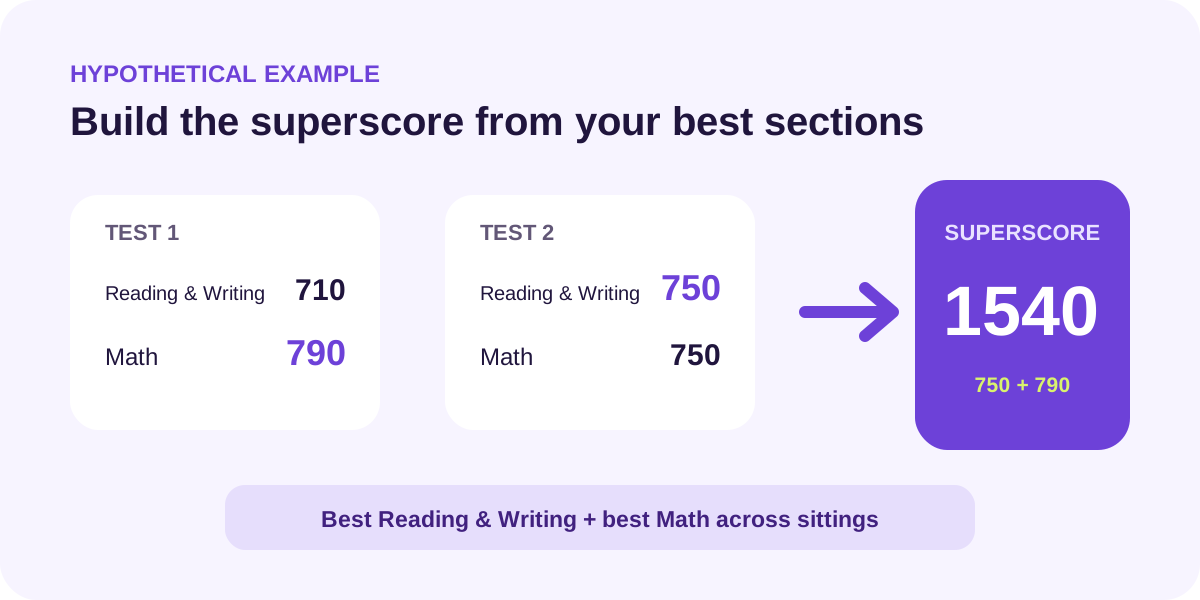
Yes. Columbia combines your highest Reading and Writing score with your highest Math score across submitted sittings. Its policy allows superscoring across paper and digital administrations. Columbia testing policy
Here is a hypothetical example:
| Result | Reading and Writing | Math | Total |
|---|---|---|---|
| Test 1 | 710 | 790 | 1500 |
| Test 2 | 750 | 750 | 1500 |
| Superscore | 750 | 790 | 1540 |
Both individual totals are 1500, but the strongest section combination is 1540. That is why you should examine your section results before deciding that a second sitting made no difference.
For preparation, identify the question types holding back the weaker section while maintaining your stronger one. A higher superscore is a planning goal, not a promised outcome of retesting.
Use the ScoreDino SAT calculator to compare supported section totals and superscores. Your official score report remains the source for the numbers you submit.
How and when should you submit scores?
Keep your test record organized: exam date, Reading and Writing score, Math score and any planned retake. Common App's application guide explains that its Testing section accepts self-reported results and that each college sets its own requirements.
Columbia permits self-reporting through the application or applicant portal. If you send an official SAT report, use code 2116. Enrolling students' self-reported scores are verified. Columbia also asks applicants not to use rush reporting. Columbia's score-reporting instructions
Application deadlines and testing dates are different
The first-year page lists November 1 for Early Decision and January 1 for Regular Decision, while noting that applicants receive cycle-specific deadline notices. For this cycle, those dates fall in 2026 and 2027, respectively. First-year deadlines
Columbia's testing guidelines allow tests through November 2026 for Early Decision and February 2027 for Regular Decision. That does not extend the application deadline. Testing guidelines
For SAT Weekend planning, compare the actual calendar:
| SAT date | Regular registration deadline | Scheduled student score release |
|---|---|---|
| October 3, 2026 | September 18 | October 16 |
| November 7, 2026 | October 23 | November 20 |
| December 5, 2026 | November 20 | December 18 |
Sources: College Board test calendar and score-release schedule.
There is no February 2027 SAT Weekend date. December 5 is the final scheduled weekend SAT before Columbia's February cutoff; the next is March 6. The broad testing window covers more than the SAT calendar.
October gives an Early Decision applicant a scheduled score release before November 1. November scores arrive afterward, so submit the application on time and follow Columbia's score-update instructions. Scheduled releases are not guarantees that every individual result will arrive that day.
What about international applicants?
Keep the SAT submission decision separate from demonstrating English proficiency.
Columbia lists several ways to meet its English requirement, including English as your home language, English instruction throughout secondary school, or qualifying test results. A 700 or higher in SAT Reading and Writing is one listed route. Columbia English-proficiency requirements
That 700 is an English-proficiency criterion, not a minimum SAT admission score. If none of the listed alternatives applies, follow Columbia's instructions for an accepted English-language exam. Check this early enough to arrange any additional testing.
Make your next study session useful
You do not need to solve your entire application today. Choose the next task that changes your decision:
- Need a reliable starting point? Take an official full-length practice test in College Board's Bluebook. Record your section results before setting a target.
- Know your weak areas? Use Khan Academy's free Official SAT Prep. Its lessons and practice questions let you work on particular skills instead of repeatedly taking full tests.
- Want live support for foundations? Schoolhouse's free SAT Bootcamps offer small-group tutoring. Its published target is 400-690 in an individual section, so check the fit before joining, especially if you already score 700 or higher.
After practice, write down why you missed each question: a concept gap, a misread, a timing decision or an execution mistake. Pick one recurring issue for your next session. Our guide to improving after a practice SAT shows how to turn those observations into a manageable plan.
A FEW MORE ANSWERS
Frequently asked questions
Is 1500 a good SAT score for Columbia?
It is just below the latest reported 1510-1560 range. That comparison helps with planning, but 1510 is not an admission cutoff. Assess what a 1500 contributes to your full application.
Can I apply to Columbia without an SAT score?
Yes, for fall 2027 entry under the 2026-2027 test-optional policy. For fall 2028 entry, the requirement changes. An ACT score is also an accepted testing route. Check the cycle table above.
Is Columbia Engineering's SAT minimum higher?
Columbia publishes no minimum admission test score for either Columbia College or Columbia Engineering. The class-profile range used here combines the two schools; it does not establish a separate Engineering cutoff.
Does a 1560 guarantee admission?
No. It matches the upper end of the published middle-50% range, but that statistic describes enrolled score-submitters. It cannot tell you the probability of admission for a particular applicant.
READ THE ORIGINALS
Sources & further reading
College Board sets the SAT scoring rules. These references also explain the testing terms, admissions context, or study methods used in this guide.
References checked .
STUDENT DISCUSSION
Join the conversation
Add a first name or nickname and your comment. Please do not include personal information.
Loading comments…