
Practice strategy 6 min read
How to improve your SAT score after a practice test
To improve your SAT score, review why questions went wrong, choose one recurring skill, and test your repair on fresh questions before taking another full test. A useful SAT practice test review includes uncertain correct answers as well as mistakes. The SAT mistake log and study plan below are suggested routines, with no promised point gain.
How can you improve your SAT score using your latest results?
Open the actual questions behind your score. For a Bluebook test, My Practice provides results, answer explanations, and options for targeted practice. College Board: My Practice 101
Try a missed question again before reading the explanation. Note the first step you cannot justify, compare your reasoning with the explanation, and write down what you would change. This follows the recall-then-check approach described by The Learning Scientists.
Review lucky guesses too. “I chose the correct option” and “I can explain the method” are different things.
What should you put in an SAT mistake log?
Record the test and question number, the cause of the error, a specific repair, and a date to check the skill again.
| What went wrong? | A useful repair | How to check it |
|---|---|---|
| I did not know the concept. | Review one explanation, then explain the idea without notes. | Solve a new question using the same skill. |
| I answered the wrong quantity. | Mark exactly what the question asks for. | Compare the requested quantity with the final answer. |
| I made an execution error. | Find the first incorrect calculation or editing decision. | Repeat that step correctly on a fresh example. |
| I ran out of time. | Check whether the underlying task is clear without a timer. | Add timing after the method is reliable. |
Choose a cause that matches what happened. “Careless” is too broad to tell you what to do next.
What does a useful correction look like?
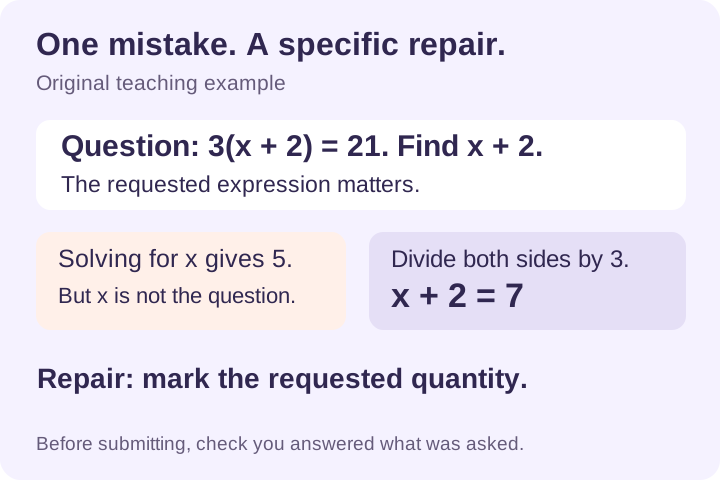
Consider this original example, not a College Board test question:
If 3(x + 2) = 21, what is x + 2?
Divide both sides by 3. The requested expression is x + 2 = 7. If you solve further and submit x = 5, you have answered a different question.
A useful log entry says: “I answered for x instead of x + 2. Next time I will mark the requested expression and check my final answer against it.”
On your next question, check whether you use that repair without prompting. This example does not indicate how many SAT points a similar mistake would cost.
How should you choose the next practice questions?
Look for a pattern that occurred more than once. College Board’s Student Question Bank lets you filter by assessment, section, domain, skill, and difficulty. College Board: Student Question Bank
If the concept itself is unclear, use Khan Academy’s digital SAT courses for skill practice before returning to fresh questions. Full-length digital practice tests are in Bluebook, rather than Khan Academy.
Start with a small set, such as five fresh questions on one skill. Five is a manageable example, not a required minimum or a validated formula. For an algebra example, try our systems of equations lesson and five original questions.
Explain each solution, including why one tempting wrong answer fails. If you stay stuck, bring a teacher or tutor the exact step you cannot explain. Schoolhouse.world’s free SAT tutoring is another place to look for help; check the current sessions and eligibility.
What could a two-week SAT study plan look like?
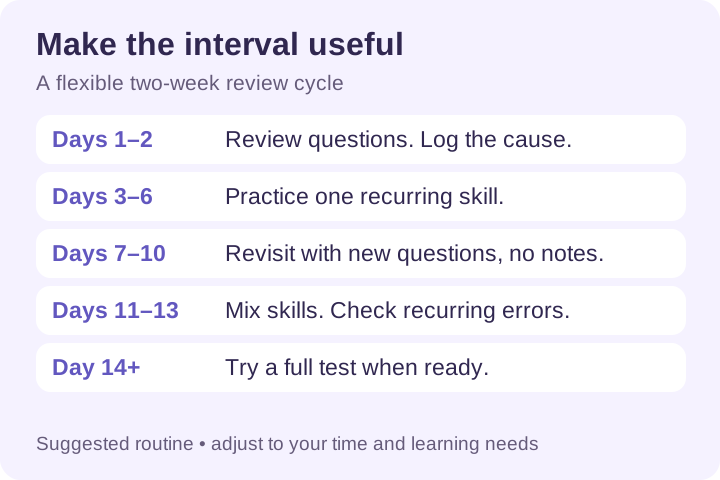
Use this as a flexible example. Adjust it around school, rest, your test date, and how much review you need.
| When | Main task | What to record |
|---|---|---|
| Days 1–2 | Review your test and classify recurring errors. | One or two priority skills. |
| Days 3–6 | Practice a priority skill with fresh questions. | The method you used and any repeated errors. |
| Days 7–10 | Revisit the skill without notes. | Whether your repair works on unfamiliar questions. |
| Days 11–13 | Mix reviewed skills and add appropriate timing. | Where understanding or pacing still breaks down. |
| Day 14 or later | Take another full practice test if ready. | Your reported result and changes in error patterns. |
College Board recommends allowing at least two weeks between full practice tests when possible. This schedule is ScoreDino’s suggested way to use that interval, not a tested score-gain program. College Board: Build Your Study Plan
The review-and-return pattern has a broader learning basis: the Institute of Education Sciences recommends spreading learning over time, and AERO’s spacing and retrieval guide explains why revisiting a skill and recalling it without notes can help retention. Neither validates this exact two-week schedule or predicts an SAT point gain.
How can you tell whether the practice helped?
Ask whether you can now explain the skill and apply it to new questions. Compare recurring errors and how the timing felt, alongside your reported scores.
A changed total does not tell you that one tactic caused every point of the difference. Keep the next decision specific: continue the repair, seek help with the concept, or move to another recurring issue.
A FEW MORE ANSWERS
Frequently asked questions
Should I take another full test immediately?
First check whether you have learned something useful from the one you finished. Targeted review can give your next test a clearer purpose.
Should I review questions I answered correctly?
Yes, when you guessed or cannot explain the method. Put those questions in your log as uncertain rather than mastered.
How many points will this routine add?
There is no reliable point-gain promise for this routine. Your starting knowledge, practice quality, test conditions, and other factors affect results.
What if I keep missing the same skill?
Reduce the difficulty, inspect the first step that goes wrong, and ask for help with that step. Bring an example and your attempted solution.
READ THE ORIGINALS
Sources & further reading
College Board sets the SAT scoring rules. These references also explain the testing terms, admissions context, or study methods used in this guide.
References checked .
STUDENT DISCUSSION
Join the conversation
Add a first name or nickname and your comment. Please do not include personal information.
Loading comments…